A clear reading of behaviour.
Understand and develop your teams’ behaviour with DISC!Our assessment reveals each person’s behavioural style: how they act, communicate, make decisions and react under pressure. We help people and leaders turn this self-awareness into concrete action.Improve your team’s performance. Adjust communication, prevent conflict and make the most of complementary profiles to create smoother, more productive workplaces. Base your management decisions on an objective reading of behaviour and reach a higher level of engagement and success.
In today’s fast-moving world, understanding how each person acts and interacts is the key to personal and collective success.
DISC is a behavioural profile assessment that identifies your style across four dimensions: Dominance, Influence, Steadiness and Compliance.
It does not measure intelligence or technical skills: it describes your observable, everyday behavioural tendencies, so you can understand and adapt them.
Discover your style and your potential
A proven methodology, grounded in Marston
Based on the original model of psychologist William Moulton Marston (Emotions of Normal People, 1928), DISC organises behaviour along two axes:
Pace: more active and assertive, or more measured and receptive,
Focus: oriented towards tasks and results, or towards people and relationships.
Crossing these two axes produces the four dimensions D, I, S and C, and 12 possible styles placed on a circular map.
More than data, a roadmap for growth
Self-awareness: identify your strengths, your needs and the environment in which you perform best.
Personalised action plan: by understanding how you react under pressure and your development priorities, you set concrete actions to grow.
Communication and relationships: learn how to work, communicate and sell with each profile.
For smoother, more effective relationships
With DISC, everyone understands their own style and that of others: it becomes easier to approach a colleague, motivate a team member or convince a client.
DISC is a simple yet powerful tool to make the most of natural talents, optimise team dynamics, strengthen leadership and create more harmonious and productive workplaces.
There is no right or wrong profile: every combination brings strengths and points to watch. What matters is recognising them and turning them into a lever for personal and professional development.

DISC can be applied to:
Leaders:
Adapting management style to each team member: how to motivate, delegate and give feedback according to their behavioural profile.
Teams:
Understanding each person’s style and how styles complement each other, to strengthen cohesion, improve communication and allocate roles better.
Sales teams:
Identifying one’s own sales approach and adapting the message to each client’s profile, from first contact to negotiation.
The EGG Science model has no limits! You can map an entire company, giving everyone a better understanding of themselves and others, which leads to significant improvements in their professional and personal lives.
What do you improve with DISC?
Targeted and effective communication:
Identify the style of each team member (direct, enthusiastic, steady or analytical) and adapt your message so everyone understands it.
Empowered Leadership
Knowing each person’s profile, you adapt how you motivate, delegate and give feedback.
Augmented Collaboration
Understanding what each profile needs (challenge, recognition, stability or precision) fosters genuine collaboration and stronger working relationships.
Constructive Conflict Resolution
Tension often comes from different styles rather than real disagreement. DISC helps you anticipate it and turn differences into complementarity.
Sales performance
Every salesperson has a style, and so does every client. DISC helps adjust the approach, arguments and follow-up to the other person’s profile.
Development under pressure
The report describes how you react under pressure and suggests development priorities and a concrete action plan.
Here are some examples of data generated by DISC:
Visualize your data clearly and precisely
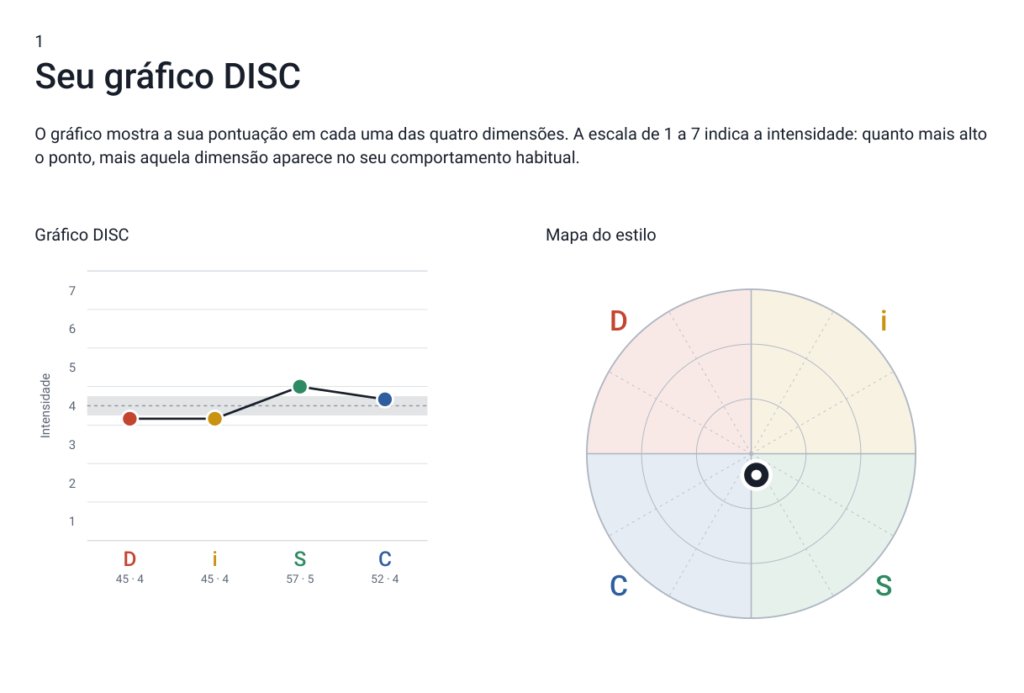
The DISC graph and style map place your profile on the four dimensions, with an intensity scale from 1 to 7.
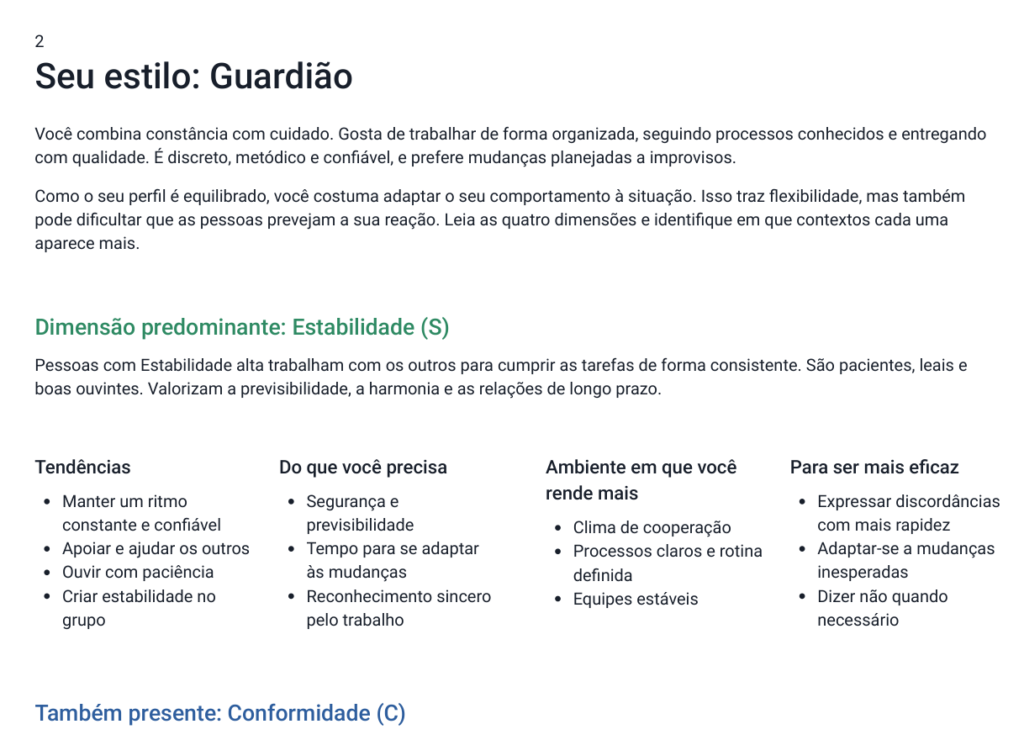
Your style is described in detail: predominant dimension, tendencies, needs, ideal environment and ways to be more effective.
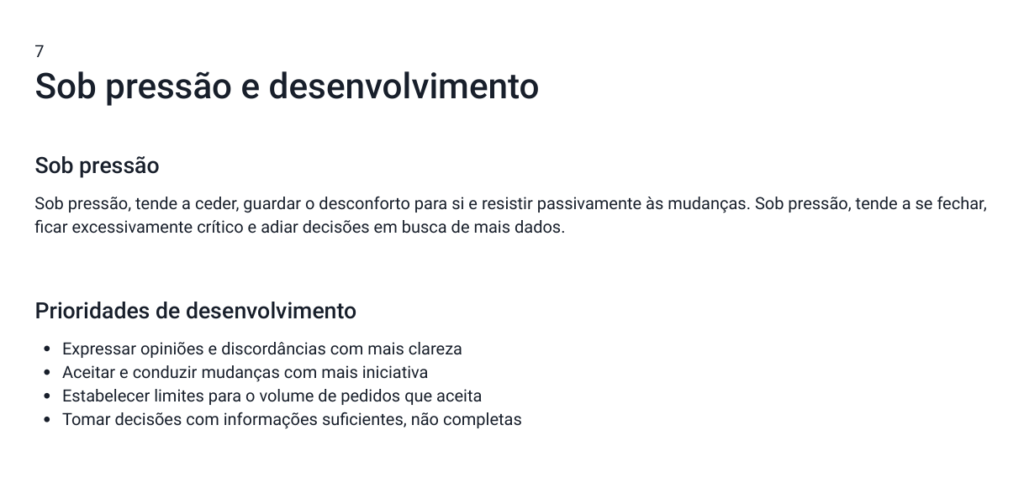
The report shows how you react under pressure and suggests concrete development priorities.
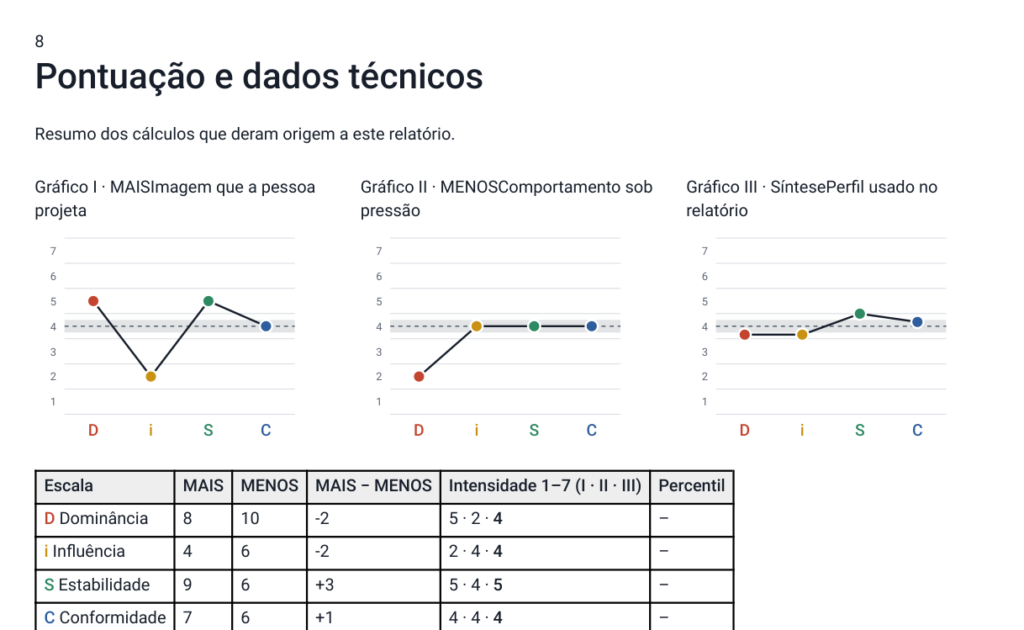
The technical data show the three readings of the profile (projected image, behaviour under pressure and synthesis) and the score for each dimension.
No magic formula, methods based on studies
We do not all react the same way to challenges, people, pace and rules. With DISC, understand your style and turn it into a strength.
Dominance describes how a person responds to challenges, problems and obstacles. People high in Dominance are direct, decisive and results-oriented: they enjoy challenges, decide quickly and focus on the end result.
They shape their environment by overcoming obstacles, speak directly and readily take responsibility for making things happen. Lower intensity points to a more cautious, cooperative and measured style.
Influence describes how a person relates to others and seeks to persuade them. People high in Influence are enthusiastic, sociable and persuasive: they communicate easily and show optimism.
They shape their environment by persuading and rallying others, enjoy being around people, make contacts easily and often decide on impressions and intuition. Lower intensity points to a more reserved, objective and factual style.
Steadiness describes how a person deals with pace, routine and change. People high in Steadiness are patient, cooperative and reliable: they value consistency and prefer planned change.
They work with others to carry out tasks consistently, are loyal and good listeners, and value predictability, harmony and long-term relationships. Lower intensity points to a more agile, restless style that is open to change.
Compliance describes how a person responds to rules, standards and quality requirements. People high in Compliance are analytical, precise and careful: they pay close attention to detail.
They work carefully to high standards, decide on the basis of data and logic, and care about doing things right. Lower intensity points to a more flexible, independent style, less bound by procedures.
What do you gain with DISC?
Individual:
You discover your behavioural style: how you act, communicate and decide, your strengths and what you need to perform at your best. You also understand how you react under pressure and which behaviours to develop.
Your relationships become smoother and more effective: you learn to adapt your communication to each person and build a concrete action plan to grow.
Corporate:
For the company, DISC provides a simple, shared language to talk about behaviour at work. Knowing the profiles, managers can allocate roles more effectively, adapt their management to each team member and improve internal communication, reducing misunderstandings and conflict.
Sales teams adjust their approach to each client, and leaders develop more empathetic and strategic people management, fostering a more harmonious and engaging workplace.
7 good reasons to adopt DISC
- A recognised model. Grounded in William Moulton Marston’s original work, DISC is one of the most widely used behavioural models in the world.
- Easy to understand and remember. Four dimensions, one shared language for the whole team.
- Quick to complete. 28 groups of four words: a few minutes are enough.
- Better communication and relationships. By understanding your style and that of others, you communicate with more empathy and persuasion.
- Build high-performing teams. Complementary profiles become an asset for collaboration and role allocation.
- Sell and negotiate more effectively. Adapt your sales approach to each client’s profile.
- A concrete action plan: development priorities, behaviour under pressure and actions to put in place.